To read the full report on Tucson’s Multifamily market activity in Q2, click here
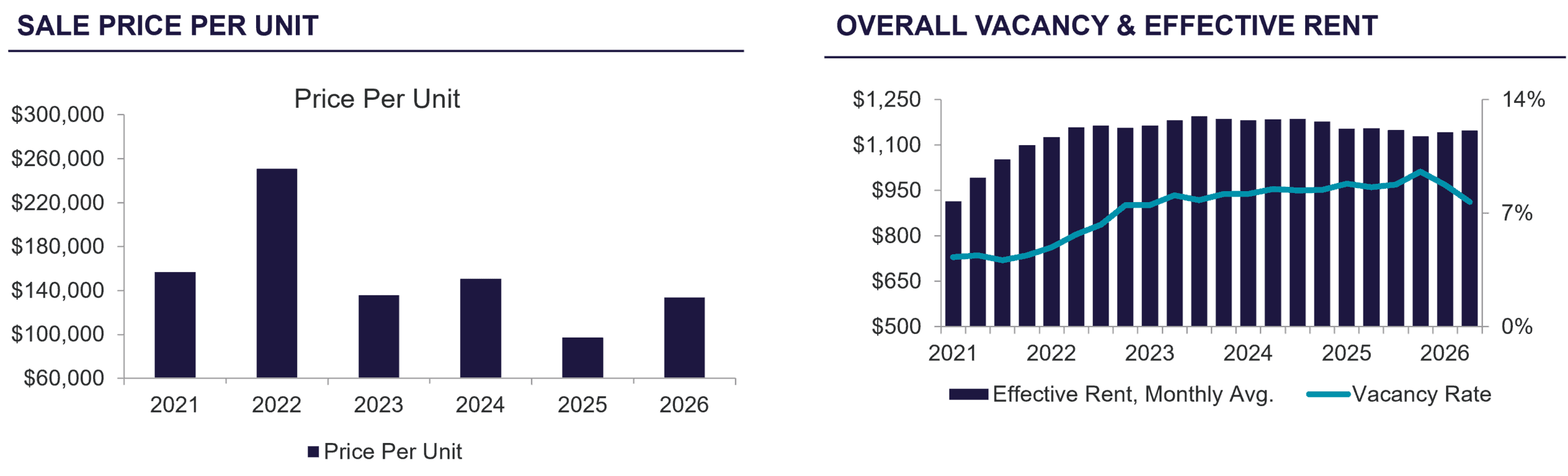
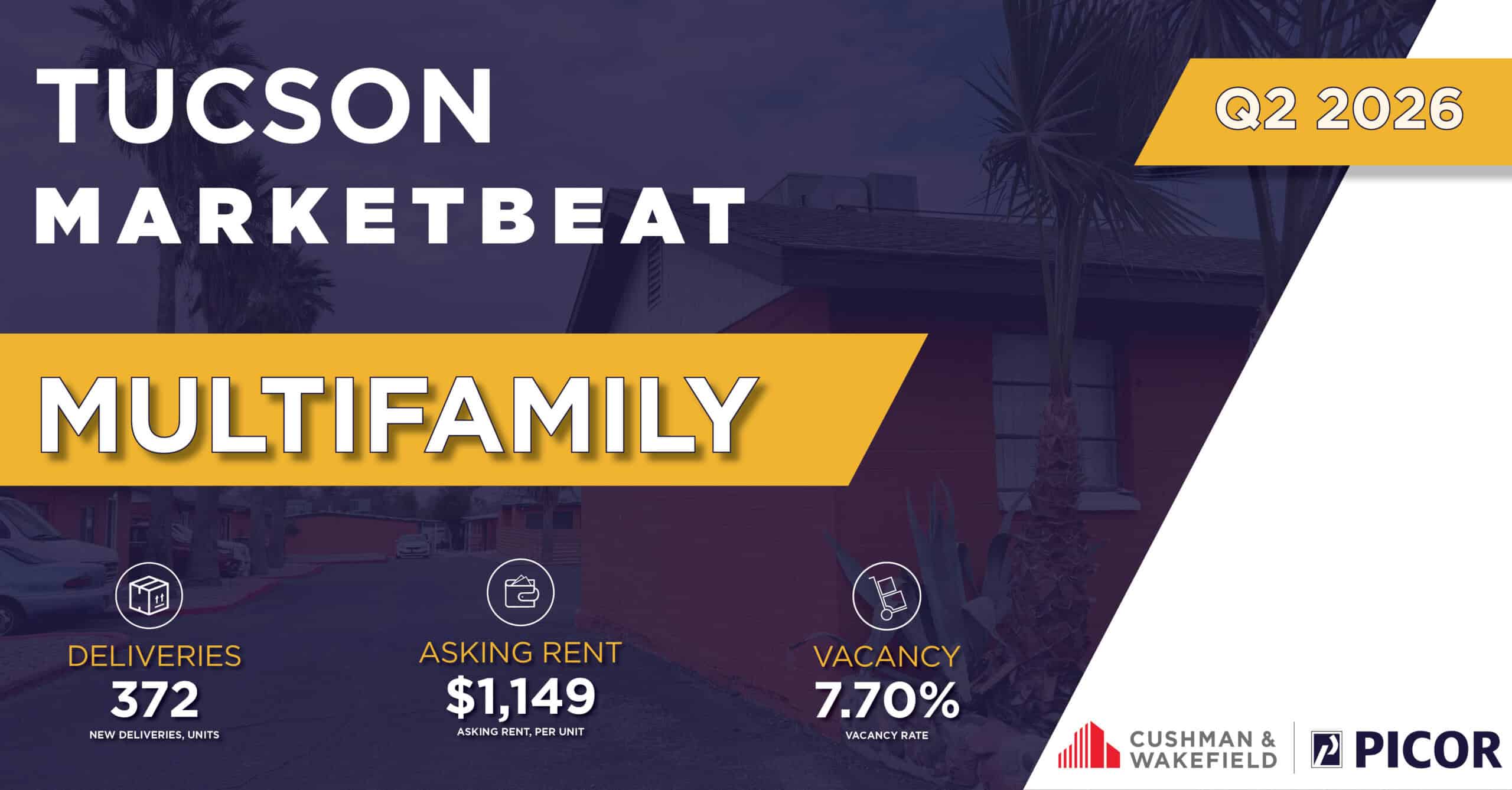
The 2026 Q2 Tucson multifamily market continued to show signs of stabilization, with vacancy declining to 7.70%, marking the second consecutive quarter of improvement as renter demand continued to absorb available inventory. 11 of the 15 submarkets recorded lower vacancy rates, led by Southeast Tucson, while South Central Tucson continues to hold the highest vacancy at 9.92%. Average asking rents increased by $7 from the previous quarter to $1,149 per unit, though they remain slightly below year ago levels. Investment sales activity remained limited, with only three recorded arm’s length transactions of properties containing 40 or more units. The average prices of $133,503 per unit and $188.19 per square foot represent a decrease of $2,591 per unit. While Investors remain focused on well-located value-add opportunities, particularly older assets, and underwriting remains conservative. Meanwhile, the development pipeline remained relatively stable with more than 7,500 units, suggesting new supply will continue to influence market fundamentals over the coming quarters.
“The Tucson multifamily market continues to show gradual stabilization as renter demand absorbs much of the new supply delivered in recent years, though vacancy remains above historical norms and competition for qualified residents persists. Well-managed communities that prioritize resident retention, responsive service, strategic pricing, and operational efficiency continue to outperform the broader market. While rent growth remains modest and asking rents often exceed current market support, owners who adapt quickly to changing conditions and focus on maintaining occupancy are achieving stronger long-term performance.” – Sarah Haynie, 520-307-4384, JDM Asset Management LLC
“The second quarter of 2026 reflected continued investor confidence in the Tucson multifamily market, with strong acquisition activity supported by six purchase financing requests averaging a 67.73% loan-to-value ratio and a 6.15% interest rate. Most of these loans locked their rates before the conflict in Iran, and subsequent geopolitical uncertainty has pushed Treasury yields and borrowing costs higher, with current multifamily financing rates generally ranging from 6.50% to 6.625%, depending on loan structure and terms. Despite rising interest rates, investor demand remains healthy, supported by Tucson’s expanding employment base, population growth, and major economic drivers, including the University of Arizona, continued development along the I-10 corridor, and the $3.6 billion Project Blue data center. While higher insurance costs and operating expenses continue to influence underwriting, Tucson’s long-term fundamentals remain favorable for multifamily investment.” – Robert Motz, 520-202-0672, Pima Federal Credit Union
Looking ahead, the Tucson multifamily market is expected to remain stable through the remainder of 2026, supported by steady occupancy, improving investment activity, and more predictable financing conditions. Rent growth is likely to remain modest, with some owners continuing to offer concessions as renters benefit from increased housing options. As buyer and seller expectations remain aligned, transaction activity is expected to continue improving, supported by a more stable financing environment. Seller financing should remain a competitive advantage, generating stronger buyer interest and supporting pricing across the market. Investor demand is expected to remain strongest for well-located properties with long-term appreciation potential, while value-add opportunities continue to emerge in select submarkets. Although rising insurance costs and operating expenses will remain challenges, the overall outlook is balanced, creating favorable conditions for disciplined, long-term investors.