Cushman & Wakefield | PICOR
Q3 2026 Multifamily Report – Written by:
Allan Mendelsberg, Principal, Multifamily Properties
Joey Martinez, Principal, Multifamily Properties
Lexy Pacheco, Brokerage Assistant
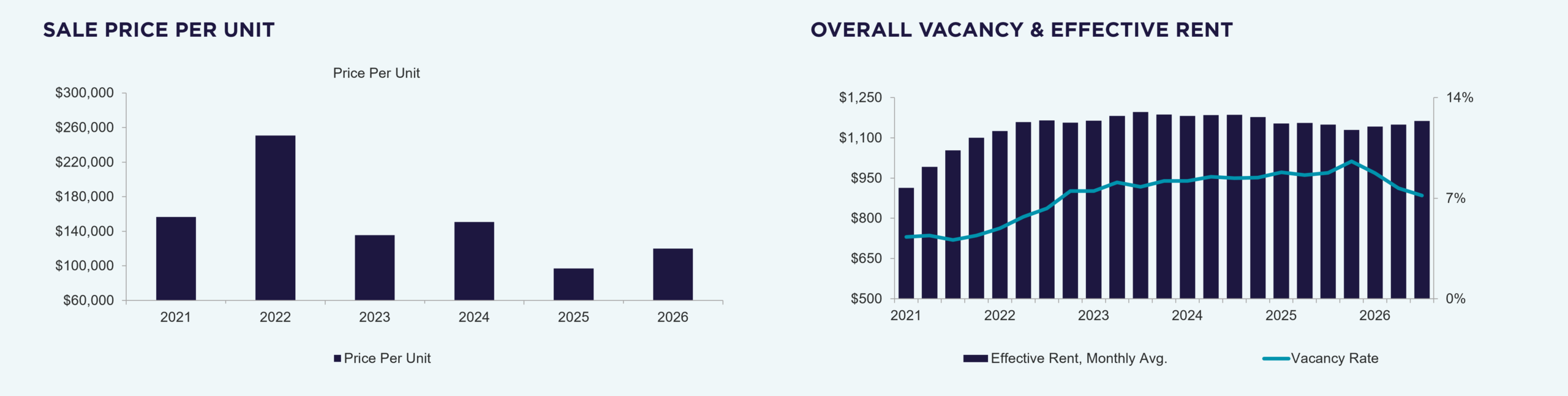
The Q3 2026 Tucson multifamily market continued to show signs of stabilization, with overall vacancy at 7.18% and average effective rents at $1,163 per unit, reflecting a 1.13% increase from a year ago. Performance varied across the reported submarkets, with Southeast Tucson recording the lowest vacancy at 3.47%, followed by Oro Valley/Catalina at 3.82%. Flowing Wells posted the highest vacancy at 9.19%, followed by Pantano/Lakeside at 8.89%. Southeast Tucson also recorded the highest average effective rent at $1,641 per unit, while North Central Tucson remained the most affordable at $929. Despite modest overall rent growth, most reported submarkets experienced annual rent declines, indicating that pricing pressure remains uneven across the market. Higher borrowing costs, rising operating expenses, and competitive leasing conditions continued to influence investment decisions, keeping buyers focused on realistic pricing, stable occupancy, and opportunities to improve operations.
“The recent market has been soft across the board. We have seen specials increase to offer up to 2 months free. In the past, it’s been half off a month or 1 month free during the slower time of the year (September– January). The specials started before the summer months and have increased as we move into the slower months. Student traffic was lower than in the past, which created more available product for prospects to choose from. According to recent articles, freshman class enrollment dropped about 20% last year and another 18.5% this year. Rental adjustments have also occurred throughout Tucson due to the increased available product and lower traffic trends. Our team has focused on timely responses for prospects, timely market rate adjustments, curb appeal of the properties, and the interior of the units. We also continue to make sure all current tenants are being helped with any issues they may come across as a renter to help with retention.” – Chris Meehan, 520-317-2922, Fort Lowell Realty
“The third quarter of 2026 reflected measured investor confidence in the Tucson multifamily market. Acquisition activity remained steady, with four purchase financing requests averaging a 68.30% loan-to-value ratio and a 6.51% interest rate. Geopolitical tensions involving Iran and resulting uncertainty have pushed Treasury yields and borrowing costs higher, with current multifamily financing rates generally ranging from 7.25% to 7.375%, depending on loan structure and terms. Investor demand has become more selective, with most buyers seeking a bona fide 7.0%+ capitalization rate to justify financing costs. While rising insurance premiums and repair and maintenance costs continue to influence underwriting and valuations, Tucson’s long-term fundamentals remain favorable. Population growth, in-migration from higher-cost Western markets, the University of Arizona, Davis-Monthan Air Force Base, Raytheon, and expanding healthcare employment continue to support rental demand. Vacancy rates remain manageable by historical standards, and well-located properties with stable occupancy and efficient operations continue to attract interest. Transaction volume remains below peak-cycle levels as buyers and sellers navigate pricing expectations; however, quality assets with strong in-place cash flow and value-add opportunities continue to generate competitive interest.” – Robert Motz, 520-202-0672, Pima Federal Credit Union
Looking ahead, the Tucson multifamily market is expected to face continued challenges as higher borrowing costs, economic uncertainty, and softer leasing conditions influence investment activity. Rent growth is likely to remain limited, with owners continuing to offer concessions and rent reductions to attract residents. Declining enrollment at the University of Arizona has placed pressure on student housing, with reduced demand also contributing to increased vacancy at some surrounding market-rate properties. Transaction activity is expected to remain subdued until buyer and seller expectations adjust to current financing conditions and capitalization rate requirements. PICOR anticipates an increase in available investment opportunities over the next 6–12 months, with inventory potentially exceeding levels observed over the past several years. Well-located properties are expected to remain more resilient, while assets in less desirable locations may face greater leasing and pricing pressure. Although these conditions will require careful underwriting and realistic pricing, expanding investment options may create opportunities for disciplined, long-term investors.