The Trend Report, March 2026 Edition
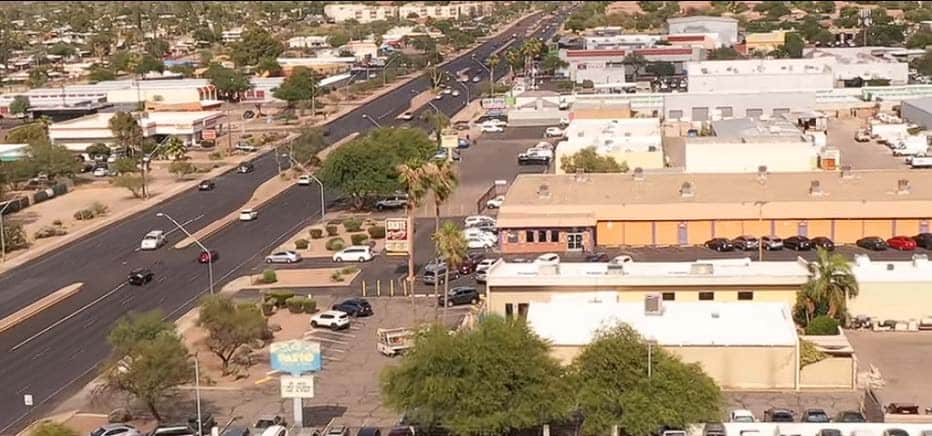
Aerial view at 22nd Street & Pantano, Tucson
“A one-story strip center on a major corridor is no longer just a retail asset. It is now potentially a mixed use development site…If you own a retail building in Tucson’s urban core, you may be sitting on more value than you realize”, said Rob Tomlinson, Principal and Retail Specialist at Cushman & Wakefield | PICOR.
How density, entitlements, and elevated new construction costs are converging to make today’s retail properties tomorrow’s most sought-after assets in the Old Pueblo.
If you own a retail building in Tucson’s urban core, you may be sitting on more value than you realize. Two converging forces—skyrocketing construction costs and sweeping new zoning flexibility—are quietly setting the stage for a dramatic revaluation of existing retail properties over the next decade. For property owners, investors, and brokers paying attention, the window of opportunity is open right now.
The Replacement Cost Wall: New Construction Is Out of Reach
Building new retail space in Tucson has never been more expensive—and the math simply doesn’t work for most tenants. When you take into account the cost of land, carrying costs during construction, and an 8–12-month entitlement timeline, retail construction costs in Arizona currently run up to $400 per square foot for standard finishes, with highly fixturized uses (restaurants, “medtail,” etc.) going well higher upon delivery. The rent required to justify new retail development is simply well beyond what the average tenant in Tucson can afford.
Consider the market reality: as of Q1 2025, Tucson’s average asking retail rent is just $20.03 per square foot—up from $19.06 a year earlier, which is about half of what is needed to underwrite new ground-up construction and provide an acceptable developer rate of return. Even in stronger submarkets like Oro Valley ($26.23/SF) or downtown Tucson ($21.11/SF), the numbers rarely pencil for new development. As Cushman & Wakefield | PICOR’s latest retail market report notes, new retail space options are limited precisely because of high construction costs—developers simply aren’t building speculatively.
This is the core of what economists call the “replacement cost floor.” When existing buildings can’t be economically replaced, they become increasingly scarce and valuable. Tucson’s retail vacancy has already tightened to 5.3% in Q1 2025—a historically healthy level—and with no meaningful pipeline of new supply, that constraint will only deepen.
The Zoning Revolution: Middle Housing and The Community Corridors Tool Changes Everything
Community Corridors Tool: After years of planning and community engagement, the City of Tucson adopted the Community Corridors Tool (CCT), a landmark addition to the Unified Development Code that allows property owners along the city’s arterial and collector streets to opt into a new zoning overlay that dramatically increases allowable density.
The implications for retail real estate are profound. Under the CCT, sites that once maxed out at two or three stories can now accommodate buildings up to six stories under the right conditions. The tool encourages active ground floors, buildings closer to the street, and reduced parking requirements, essentially unlocking the potential for mixed-use, transit-oriented development on parcels that were previously constrained. Targeted corridors include major arteries like Grant Road, Speedway Boulevard, Oracle Road, and Alvernon Way, as well as collector streets such as Pima St. and Prince Rd.
For retail property owners, this is not just a housing story, it is a land value story. A one-story strip center on a major corridor is no longer just a retail asset. It is now potentially a mixed use development site. The underlying land is worth more, the property’s redevelopment potential is dramatically higher, and the range of buyers and investors interested in the asset has expanded significantly.
The city faces a housing shortage of at least 8,000 units today, with that deficit projected to grow to more than 43,000 by 2035. That kind of pressure does not go away—it turns corridor retail land into a premium resource. And importantly, only 12% of Tucson’s land is currently zoned for higher-density housing. The CCT changes that math along the streets where most of Tucson’s retail already sits.
Middle Housing: In December 2025, the Tucson City Council voted 6–1 to go far beyond what state law required, approving a Middle Housing Code Amendment that allows duplexes, triplexes, fourplexes, townhomes, and cottage courts to be built in virtually all residential zones across the city’s entire 243-square-mile area. The vote was driven by Arizona House Bill 2721, signed into law in 2024, which required cities over 75,000 in population to allow middle housing within one mile of their central business district. Tucson (and Flagstaff) chose to apply the rules citywide.
The significance of this for retail property owners cannot be overstated. Wherever middle housing takes root—and it will, retail demand will follow. As always, “retail follows rooftops”; now the new rooftops will not all be on the evolving edge, they will be in midtown. More households per block means more foot traffic, more daily spending, and more pressure on existing retail supply. A neighborhood that transitions from single-family homes to a mix of duplexes, triplexes, and townhomes can see its daytime and evening population double or triple over time.
Complementing the middle housing rules, Tucson also expanded its Accessory Dwelling Unit (ADU) regulations in 2024 in response to state House Bill 2720, which now requires cities to allow up to two ADUs per residential lot—one attached, one detached. With no parking requirements for ADUs and relaxed size limitations, these small secondary units are already proliferating across urban Tucson neighborhoods. Each one represents an additional household—and an additional customer base for nearby retail.
Two Forces, One Conclusion
Put these two forces together and the investment thesis becomes clear. Existing retail buildings in Tucson’s urban core cannot be economically replaced—making them a finite commodity. At the same time, the land beneath them has just been unlocked for higher and better uses than at any point in the city’s history. On top of all that, urban densities are likely to skyrocket in the next decade increasing the current customer base to new levels.
Property owners who understand this dynamic have several options: hold and benefit from rising rents driven by constrained supply, sell into a market where values have quietly increased, or partner with developers to unlock the full mixed-use potential of their corridor parcels. Investors looking for economically durable, supply-constrained retail assets with embedded upsides should be taking a hard look at Tucson’s urban core today before the broader market catches on.

Rob Tomlinson has been a commercial real estate broker since 1996. His work on a wide variety of commercial projects coupled with his education in Urban Geography, Site Analysis, and Land Use Planning gives him a wealth of experience in the development process. He can be reached at rtomlinson@picor.com.


